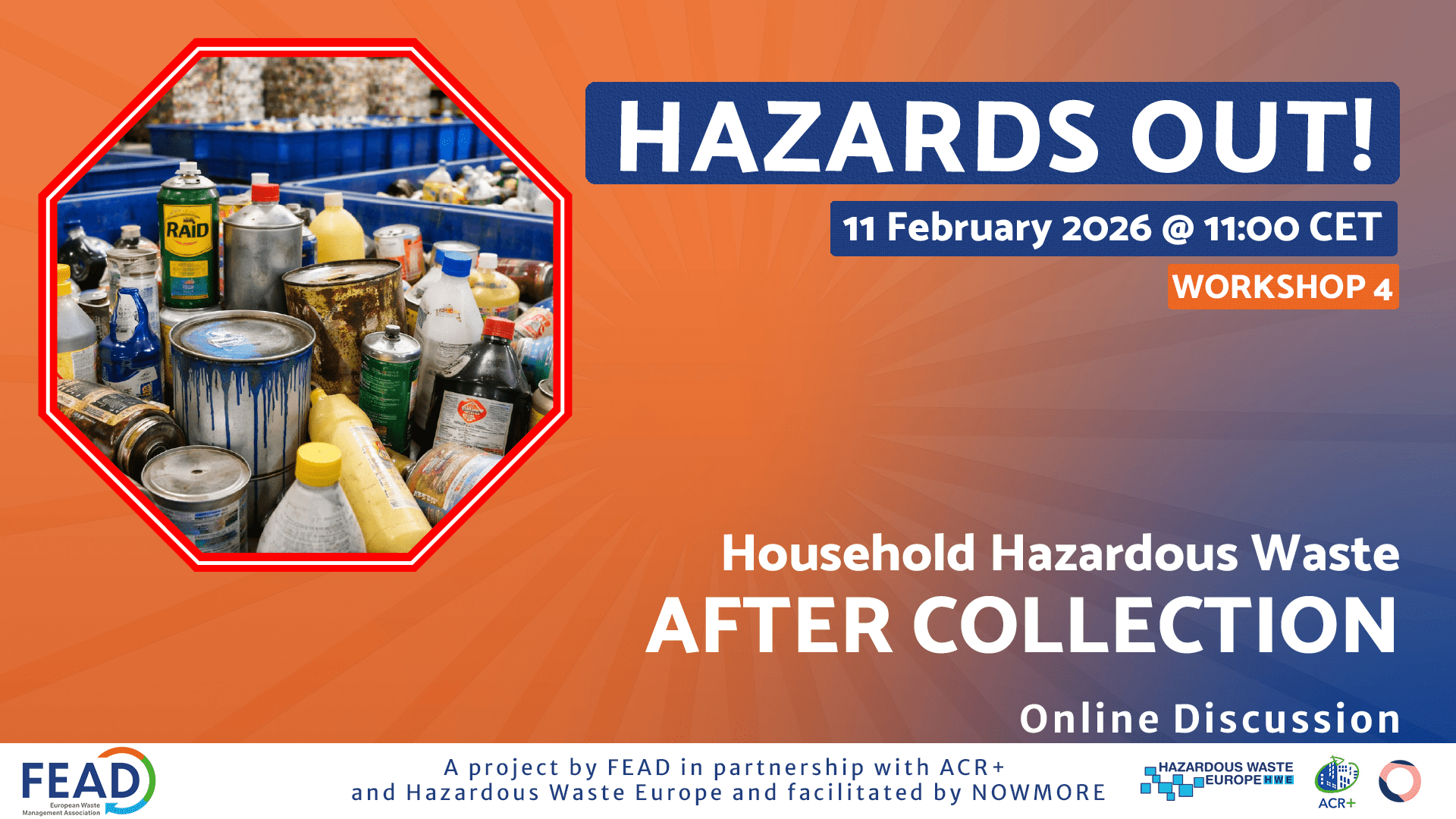
Workshop 4 of the Hazards Out series of events took place on 11.02.2026 gathering 100 experts from the waste management and recycling sector, public and local authorities, consultancy and academia, NGOs and civil society and other industries to explore the operational aspects of Household Hazardous Waste (HHW) management including logistical, technical and regulatory complexity that follows “after collection”.
The event was organised within the Hazards Out! project – a multistakeholder partnership aimed at raising awareness on the mandatory separate collection of household hazardous waste (HHW) in Europe and supporting local authorities and other relevant stakeholders in the establishment of effective HHW management strategies. Through the organisation of a series of thematic workshops the partnership promotes the exchange of best practices and collaboration among a community of professionals addressing household hazardous waste.
Gabriel Chifflier, Vice Chair of the Working Group on Hazardous Waste at the International Solid Waste Association ISWA, opened the session by establishing the operational framework for HHW management and presenting key principles for good HHW management. A core message of his intervention was: “Hazardous waste must not be mixed with non-hazardous waste” emphasising the importance of separate collection.
From prevention and minimisation to segregation at source, accessible collection systems, safe storage and environmentally sound treatment, he presented a structured set of principles and practical “Do’s and Don’ts” for both local authorities and operators. He stressed that good HHW management is not only about regulatory compliance, but about protecting human health, preventing industrial accidents and avoiding long-term environmental harm. He concluded that “The effective management of household hazardous waste is a shared responsibility between households, local authorities, and waste management operators. It can be only achieved with dedicated collection systems, strong public engagement, experienced and well-trained operators, and clear roles and collaboration.”
Clément Leveaux, Sales Development Europe Director at Veolia – Hazardous Waste Europe, provided insights into the operational realities of managing hazardous waste across multiple European countries. Presenting Veolia’s industrial expertise, he underlined the importance of risk control and technical capacity. “Logistical resources and service quality are the key factors before the adapted treatment and recovery.”
Unlike large homogeneous industrial waste flows, household hazardous waste is characterised by small, dispersed volumes, multiple packaging types and highly variable composition. This creates significant operational challenges that also vary from country to country. Leveaux highlighted three main organisational models across Europe – national, regional and municipal systems, but reiterated one common principle: hazardous waste must remain strictly separated and traceable. He also stressed that excellence in logistics and pre-treatment is as important as final treatment capacity. ADR-compliant transport, trained staff, laboratory analysis and secure transfer platforms are critical to ensuring safe recovery. Looking ahead, he pointed as a major trend the gradual move from purely local markets toward pooling of treatment capacity at European level.
Richard Kennedy, Managing Director of Enva Ireland, offered a detailed national case study illustrating the progress but also structural challenges of the HHW management on an island. Ireland generates approximately 5–7 kg of HHW per household annually, collected mainly through civic amenity sites and mobile collection days. While the country has made significant progress in expanding domestic treatment capacity over the past decade, it remains heavily reliant on export. According to Kennedy, the operational challenges on the ground include poor segregation and unknown chemicals; high transport and insurance costs; small and inconsistent quantities; seasonal peaks (e.g. paint disposal); and increasing regulatory and safety requirements.
He highlighted paint as a particularly illustrative example where reuse and social enterprise initiatives exist, but scalability remains limited. Developing end-of-waste criteria for paint would require broad stakeholder collaboration, increased public awareness and long-term offtake guarantees.
A key takeaway from the Irish experience was that better circular solutions often require more technical capacity and expertise but may involve higher operational risk and cost in the short term. “Through investment in infrastructure and innovation but most importantly investment in people and awareness raising, we can secure long term effectiveness of the HHW systems.“
Hazards Out Workshop 4 reaffirmed that managing household hazardous waste is not merely a technical exercise but a matter of risk governance, operational excellence and long-term strategic planning. The discussions made clear that effective HHW management after collection depends on systemic coordination: local authorities, operators, regulators and citizens should all play a key role.
The Hazards Out project will continue with further workshops, addressing specific HHW topics and exploring local and national case studies, industrial expertise, as well as communication and awareness raising efforts. The Hazards Out team extends its gratitude to the expert speakers and active participants for their contributions to building a safer and more circular approach to household hazardous waste management in Europe.